
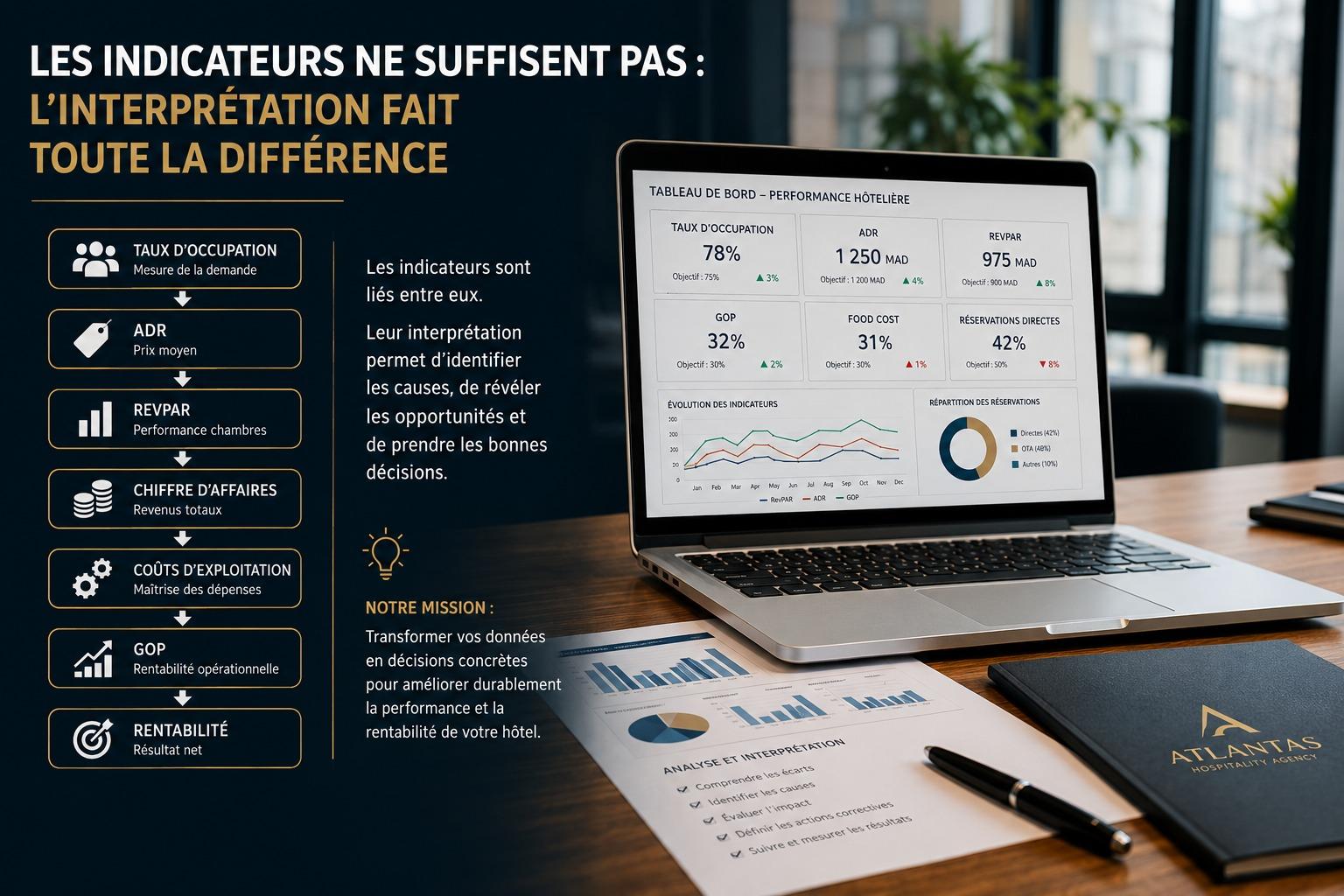
Today, most hotels, riads, and guesthouses track performance indicators such as occupancy rate, ADR (Average Daily Rate), RevPAR (Revenue per Available Room), GOP (Gross Operating Profit), Food Cost, and Beverage Cost. These indicators are indispensable: they measure activity and let you follow how the establishment evolves. But a common mistake is to think that simply calculating them is enough to improve performance. In reality, an indicator only has value if it is correctly interpreted. A figure taken in isolation does not allow you to make a decision. It must be analyzed in context, compared with other indicators, put in perspective against the establishment's objectives, and confronted with operational reality.
A concrete example
Imagine a hotel showing an occupancy rate of 85%. At first glance, the result looks very satisfying. Yet it absolutely does not let you conclude that the hotel is performing well. Several situations can explain insufficient profitability: an ADR below the market, revealing an overly aggressive pricing policy; heavy dependence on OTAs (Booking.com, Expedia…) that generates significant commissions; operating costs rising faster than revenue; a payroll too high relative to the level of activity; or a Food Cost or Beverage Cost above sector standards. In this situation, a high occupancy rate actually masks performance that could be much better.
Conversely, an establishment showing 70% occupancy can record higher profitability thanks to a better Revenue Management strategy, a higher ADR, a large share of direct bookings, excellent control of operational costs, and rigorous management of purchasing, stock, and human resources. This hotel welcomes fewer guests, but creates more value.
Understanding the relationships between indicators
Performance analysis never consists of examining a single KPI. It relies on understanding the interactions between several indicators. For example: a rise in occupancy can cause a drop in ADR if prices were cut too far; an increase in revenue can come with a decline in GOP if costs are not controlled; an excellent RevPAR can be penalized by OTA commissions that are too high; and a satisfactory Food Cost can hide significant waste if sales volumes fall. It is this overall reading that reveals the true levers of performance.
Our approach
At Atlantas Hospitality Agency, we believe dashboards are not an end in themselves. Our mission is to turn data into decisions. We analyze indicators as a whole, identify the causes of variances, evaluate their impact on profitability, and propose concrete, measurable action plans adapted to each establishment's objectives. Because in the end, it is not the indicators that improve a hotel's performance, but the decisions made through their interpretation.