
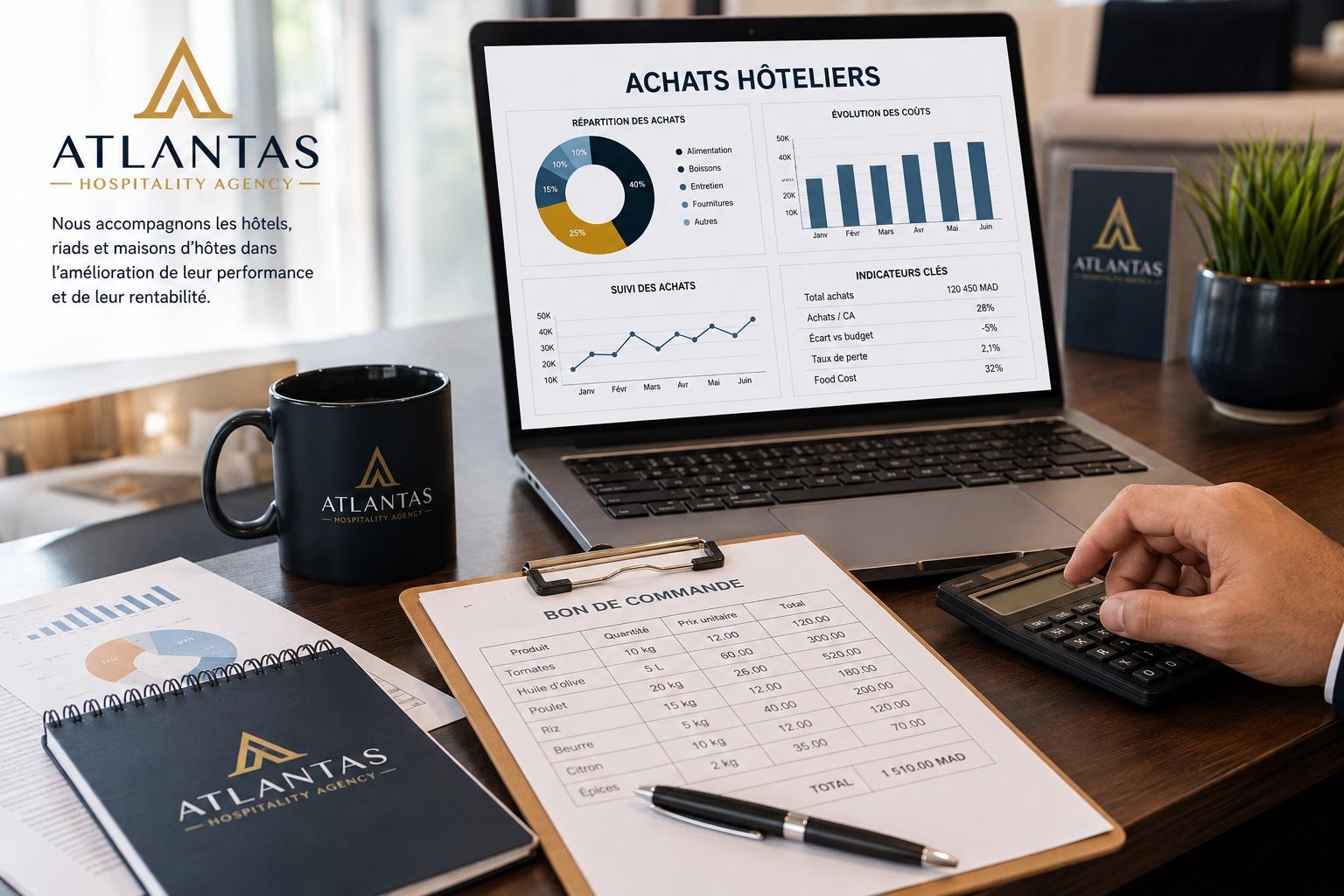
In hospitality, hotel profitability does not depend on revenue alone. It also depends on the establishment's ability to control its costs and optimize its operations. Among the most important levers is the management of hotel purchasing. Food, beverages, cleaning products, linen, supplies, equipment, or consumables: every purchase has a direct or indirect impact on the financial performance of a hotel, riad, or guesthouse. Good purchasing management therefore lets you better control spending, improve margins, and durably strengthen hotel performance.
Why is hotel purchase control essential?
Purchase control is an important element of an establishment's financial and operational steering. A poorly negotiated supplier price, an excessive order, an insufficiently checked delivery, or badly managed stock can quickly increase operating costs. A good purchasing policy must answer four essential questions: What to buy? How much to buy? At what price? And from which supplier? The goal is not simply to seek the lowest price — it is to find the best balance between price, quality, availability, payment terms, and supplier reliability.
1. Regularly compare supplier prices
Comparing prices is one of the first steps of good purchase optimization. The prices of food, beverages, cleaning products, and consumables can change regularly. A periodic comparison identifies price gaps and lets you negotiate better terms with suppliers. For strategic products, it is recommended to track:
- The product.
- The purchase unit.
- The unit price.
- The supplier.
- The quality.
- The delivery conditions.
- The payment terms.
- The price trend.
This method improves cost control and supports decisions based on real data.
2. Put hotel purchasing procedures in place
A good purchasing procedure starts with identifying a real need. Setting up a purchase order lets you specify quantities, references, negotiated prices, and the supplier concerned. It also secures the entire chain: Order → Delivery → Receiving → Invoice → Payment. This organization reduces unplanned purchases and improves the establishment's internal control. For a hotel, riad, or guesthouse, formalizing purchasing procedures contributes directly to better operational performance.
3. Control goods receiving
Receiving is an essential step of purchase control. The staff responsible for receiving must check:
- The quantities delivered.
- The prices.
- The weights.
- The conformity of the products.
- The expiry dates.
- The condition of the packaging.
- The transport conditions.
- The temperature when necessary.
It is important to systematically compare: Purchase order ↔ Delivery note ↔ Invoice. A difference that seems small on a single day can represent a significant loss when it repeats over several months.
4. Improve hotel stock management
Stock management is directly linked to profitability. Excessive stock ties up cash and increases the risk of losses, spoilage, and expiry. Conversely, insufficient stock can cause shortages and disrupt operations. Monitoring should focus in particular on:
- Minimum and maximum stock levels.
- Product rotation.
- Slow-moving products.
- Perishable products.
- Inventory variances.
- Losses and downgraded products.
Comparing theoretical stock with physical stock lets you quickly identify anomalies.
5. Control purchases and consumption
Purchase control becomes even more effective when combined with consumption tracking. In the Food & Beverage department, it is important to compare purchases with revenue and with theoretical consumption. The Food Cost is an essential indicator for measuring the cost of goods relative to restaurant revenue. Variances can come from several factors:
- Excessive portions.
- Waste.
- Storage errors.
- Losses.
- Receiving problems.
- Production errors.
- Unrecorded consumption.
- Management anomalies.
Analyzing these variances reveals the real causes of losses and improves hotel profitability.
6. Negotiate effectively with suppliers
Negotiating with suppliers should not focus on price alone. An establishment can also negotiate:
- Payment terms.
- Delivery conditions.
- Volume discounts.
- Minimum quantities.
- Return conditions.
- Lead times.
- Settlement terms.
A good purchasing strategy develops durable professional relationships while maintaining regular competition among suppliers.
7. Put performance indicators in place
Steering hotel purchasing should rely on simple, regularly tracked indicators. Among the main KPIs: the purchases-to-revenue ratio, which measures the weight of purchases in the establishment's activity; the trend in purchase prices, which quickly flags increases on strategic products; the gap between theoretical and physical stock, which surfaces inventory anomalies and consumption problems; the loss rate, which measures the impact of expired, damaged, or wasted products; and the Food Cost, which tracks the cost of goods relative to F&B revenue and is a major indicator of cost control.
Buy cheaper or buy better?
The supplier offering the lowest price is not always the most profitable one. A cheaper product of lower quality can lead to more losses, higher consumption, or a drop in service quality. The true goal of purchase optimization is therefore to seek the best overall cost. You must consider: price + quality + availability + delivery + payment terms + potential losses. This approach leads to better decisions and protects the margin.
The impact of purchasing on hotel profitability
Controlling purchasing is a direct lever for improving profitability. Better price negotiation, rigorous receiving control, effective stock management, and regular consumption analysis reduce costs without necessarily lowering service quality. The aim is durable, controlled savings while preserving:
- Product quality.
- Service quality.
- Guest satisfaction.
- Product availability.
- Continuity of operations.
Performance is therefore not simply about buying cheaper, but about buying at the best cost, controlling consumption, and reducing losses. This approach contributes directly to improved margins and the establishment's operational performance.
Hotel audit: identifying possible savings
A hotel audit goes further than a simple check of invoices. The objective is to analyze the whole process: Need → Order → Purchase → Receiving → Storage → Consumption → Analysis. This approach identifies dysfunctions, losses, non-optimized purchases, and improvement opportunities. For hotels, riads, and guesthouses, a hotel audit in Marrakech can analyze purchasing procedures, stock, Food Cost, operating costs, and performance indicators.
Why call on a hotel consultant?
Setting up an effective purchase-control system requires an approach that is both operational and financial. A hotel consultant can support management with:
- Analysis of purchasing procedures.
- Supplier audit.
- Price analysis.
- Receiving control.
- Stock analysis.
- Food Cost tracking.
- KPI implementation.
- Identification of potential savings.
The goal is to turn operational data into decisions that improve the establishment's performance and profitability.
Conclusion
Hotel purchasing should not be seen as a mere administrative function. It is a genuine lever of hotel performance and profitability. An effective organization rests on a coherent chain: Plan → Order → Receive → Control → Store → Consume → Analyze. Each step must be tracked and measured. In a competitive market like Marrakech, mastering purchasing can help hotels, riads, and guesthouses protect their margins while maintaining service quality.
Atlantas Hospitality Agency: consulting and hotel performance in Marrakech
Atlantas Hospitality Agency supports hotels, riads, and guesthouses in improving their operational performance and profitability. Our support can cover in particular:
- Hotel audit.
- Control of hotel purchasing.
- Analysis of operating costs.
- Food & Beverage control.
- Food Cost tracking.
- Hotel stock management.
- Setting up dashboards.
- Improving operational procedures.
- Profitability optimization.
Buy better, control better, consume better: three essential levers for building durable hotel profitability.